A room drops out of the opening phase, leaving furniture on order for a space that will stay closed. The project needs fewer pieces now. That does not establish how many pieces the supplier will cancel, what the change will cost or how much cash will come back.
Before removing the line from the budget, assemble a reduction request tied to the acknowledged order. Ask for a written decision on the affected goods and keep the original commitment visible until that decision is resolved.
Identify the exact goods you want to reduce
Start with the current order acknowledgment and the latest room allocation in your FF&E matrix. List the item IDs, configurations, ordered quantities and destinations that have changed. Separate pieces already received from goods still with the supplier; cancellation and return are different requests.
Show the original quantity, the quantity you still need and the proposed reduction for each item. Do not cancel an entire collection name when one finish or room type is affected. If furniture is still needed in a later phase, say whether you are asking for fewer goods, a later shipment or storage. Obtain terms for that particular request rather than treating the three options as equivalent.
Ask the supplier for the current production and material status of the affected lines. A future scheduled shipment does not tell you whether custom fabric has been bought or a frame has already been built.
Read the applicable cancellation conditions
Have the authorized contract reviewer identify which agreement and terms govern the order. Look for the required request method, the point at which a reduction can be considered, restrictions on custom goods, charges and the person authorized to accept the change.
MityLite's published terms illustrate why the details matter. They require written cancellation or quantity-reduction requests to be received at least ten business days before scheduled shipment; later requests may be declined. Custom, non-stocked or built-to-order goods are generally non-cancellable. If materials have been procured or production begun, charges may include their full specific material cost and/or the full goods invoice less applicable freight if the goods cannot reasonably be repurposed. Approved standard-goods reductions carry a 20% fee on the affected invoice value. Special orders may require executive review, and eligibility remains subject to the seller's decision. A conflicting written contract signed by both parties prevails to the extent of the conflict.
Those are one manufacturer's conditions, not the cancellation policy for every furniture seller. Meeting a request deadline does not guarantee acceptance. Use the actual agreement and supplier response for your order.
Request a decision with its financial consequences
Send the supplier one itemized request through the agreed order channel. Ask it to distinguish the quantity accepted for reduction from the quantity that remains committed, with the applicable charge and its basis.
Keep these fields together:
| Question | Evidence to retain |
|---|---|
| Which goods are affected? | Order line, exact configuration and requested quantity reduction |
| What is the supplier's decision? | Accepted quantity, declined quantity and written decision reference |
| What does the change cost? | Itemized cancellation, material, production or other applicable charges |
| How is money already paid applied? | Deposit allocation, confirmed refund or credit, or remaining amount due |
| What stays on order? | Revised goods, quantities, prices and acknowledged dates |
| What must happen next? | Buyer authorization, supplier amendment and payment or refund action |
Mark unresolved amounts as unresolved. An unpriced cancellation is not a zero-cost cancellation, and a proposed credit is not cash received.
If the response raises a disputed contractual charge, refer it to the authorized reviewer. Do not erase the liability from the project record or change a due payment unilaterally while that review is open.
Distinguish reduced commitment from a cash refund
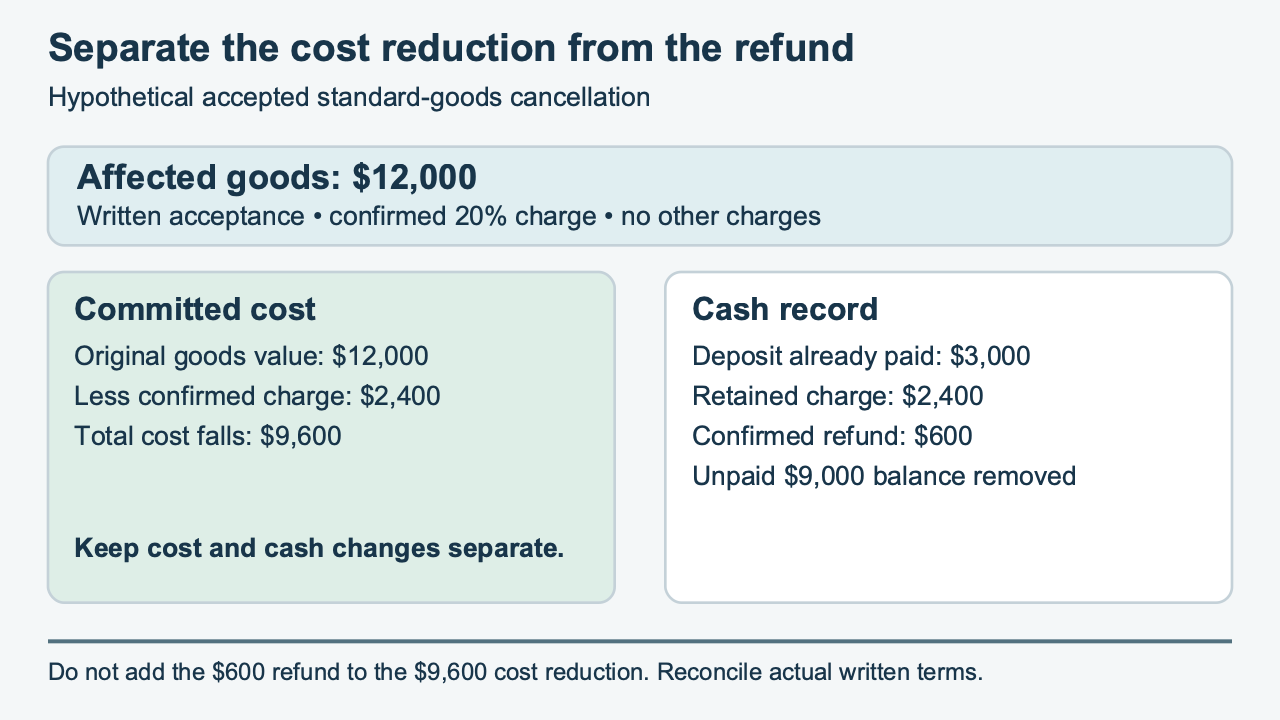
Consider a hypothetical accepted cancellation of standard goods with an affected invoice value of $12,000 and an agreed 20% charge. Assume the supplier confirms that no other charges apply and that the entire $3,000 deposit for those goods will be applied to the cancellation charge.
The charge is $2,400. The total committed cost falls by $9,600, but the cash refund is only $600: the $3,000 already paid less the $2,400 retained charge. Under these stated assumptions, the unpaid $9,000 goods balance is removed by the accepted cancellation.
These are different changes to different records. The budget records the $9,600 reduction in final cost, while the cash plan records the confirmed $600 refund and removal of the $9,000 future payment. Do not add the refund to the cost reduction and claim $10,200 of savings. That counts part of the same change twice.
The example assumes written acceptance, a confirmed deposit allocation and no further charges. If only part of the request is accepted, or the deposit also covers retained goods, rebuild the calculation from the supplier's actual itemized response. A deposit amount does not cap the possible cost of cancelling custom production.
Close the change in the opening records
Once the authorized buyer accepts the supplier's proposal, obtain the revised acknowledgment or agreed amendment. Compare the retained item quantities with the revised room allocations. A smaller order can still leave the first opening phase short if the wrong units were removed.
Update the committed cost and the deposit and draw calendar separately. Record a refund's agreed amount and timing, then mark it received only after finance confirms receipt. Keep any unresolved charge or refund with its owner and next action.
Finally, give receiving and installation teams the accepted revision. Preserve the previous order and the reduction decision beside it, so a later delivery or invoice can be reconciled without reopening the email history. The change is complete when the supplier, budget and room schedule describe the same remaining order.