A furniture deposit fits the cash balance, so the owner approves it. The whole order may still exceed what the opening budget can carry. Paying the first installment does not remove the balance, and an unresolved lighting or installation allowance has not disappeared because its invoice has yet to arrive.
Before releasing another order, calculate the maximum new furniture commitment the approved plan can absorb. Use the whole accepted order cost for that decision. Then test its payment dates in the cash calendar as a separate step.
Choose a budget boundary everyone can recognize
Start with one approved funding allocation and name what it includes. It might be the furniture allocation alone, or a combined opening allocation that also protects operating cash. Do not switch between those boundaries halfway through the calculation.
For a combined allocation, list the remaining uses of that funding: existing commitments, essential scope not yet ordered, protected operating funds and contingency. Each dollar belongs in one place. If operating funds sit outside the chosen allocation, do not subtract them again. If they sit inside it, do not silently make them available for furniture.
The fit-out budget framework helps identify the categories. This calculation uses your approved amounts within those categories; it supplies no benchmark price, recommended reserve or assurance that the project is adequately funded. Have the person responsible for the project's finances accept the boundary and inputs.
Count full commitments, including the unpaid part
For each accepted order already drawing on the allocation, enter its full approved cost once. Do not enter the full order and then add the deposit as another cost. Likewise, do not enter only the deposit and leave the balance out.
Keep the commitment record beside the payment record:
| Order | Full approved commitment | Paid to date | Unpaid amount |
|---|---|---|---|
| Illustrative existing furniture order | $20,000 | $5,000 | $15,000 |
The order consumes $20,000 of the chosen allocation. The $5,000 already paid and $15,000 still due explain its cash position; they total the same commitment.
Use the actual accepted scope. Identify freight, installation and other required costs that are outside the product order and keep their allowances in the appropriate separate line. Ask the responsible team to confirm tax treatment and contract obligations rather than copying a percentage from another project.
Hold space for essentials that are not yet ordered
An essential item awaiting selection needs an allowance with an owner, a scope and a basis. A blank price is not a zero price. Mark whether the amount comes from a current proposal, a project estimate or an unresolved assumption that needs review.
When that item is ordered, replace its allowance with the accepted commitment. Do not add the new order while leaving the same allowance in the remaining-scope total. If the accepted amount differs, show the change and recalculate the ceiling.
Keep optional later work separate. The two-phase furniture package example shows how a later courtyard option stays outside the first-opening purchase. A separately priced option does not become essential current scope merely because the supplier included it in the proposal.
Calculate the ceiling for the next order
Use this arithmetic after the budget owner has resolved which amounts belong within the boundary:
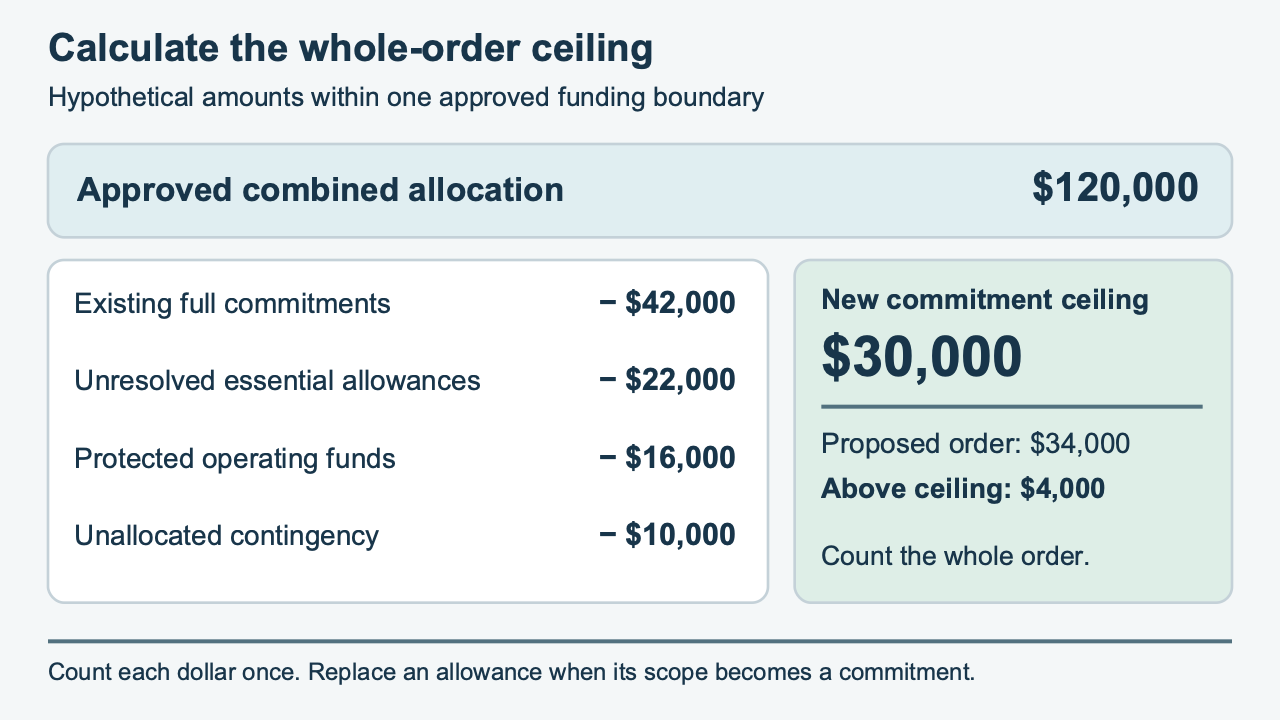
New furniture commitment ceiling = approved allocation − existing full commitments − unresolved essential allowances − protected funds − unallocated contingency
All five entries below are hypothetical. They illustrate the calculation and are not suggested funding levels or costs for an opening.
| Entry within this combined allocation | Amount |
|---|---|
| Approved allocation | $120,000 |
| Existing full commitments | $42,000 |
| Unresolved essential allowances | $22,000 |
| Protected operating funds | $16,000 |
| Unallocated contingency | $10,000 |
| Ceiling for the new furniture commitment | $30,000 |
The result is 120,000 − 42,000 − 22,000 − 16,000 − 10,000 = 30,000.
A proposed complete order of $34,000 exceeds that ceiling by $4,000. If its hypothetical deposit is 25 percent, the first payment is $8,500 and the remaining amount is $25,500. The small first payment does not make the $34,000 commitment fit a $30,000 ceiling.
Actual payment terms vary. MityLite's published terms, for example, state 50 percent prepayment for custom orders, with lead time measured from receipt of prepayment. That is a specific manufacturer's term, not the assumption used in this example or a standard for every supplier.
Resolve a proposal that exceeds the ceiling
Return to the room list and accepted specification. Identify whether a current optional scope can be deferred, whether retained furniture can serve an approved use, or whether a different quoted configuration can meet the actual requirements. Keep suitability and access reviews intact; a lower price is not approval of a changed product.
If the owner chooses to change the funding allocation or release a protected amount, record that as a separate authorized decision and recalculate. Do not conceal it by relabeling operating cash as furniture contingency. If essential allowances are still too uncertain to establish a defensible ceiling, get those inputs resolved before treating the result as authority to spend.
Once the whole commitment fits, put its deposit and balance dates into the payment calendar. The project must pass both checks: enough approved allocation for the commitment and enough available funding when each payment is due. Neither result can stand in for the other.
Save the calculation with the accepted quote revision and the name of the person who authorized the order. Update it when another commitment, essential allowance or approved allocation changes. The next furniture decision should begin from that current record, rather than from the balance showing in the bank account that morning.